Guide
Labrador weight: how to tell if your Lab is at a healthy weight
The number on the scale is only half the answer. Your hands and eyes, using a 9-point body condition chart, tell you whether that number is right for your Lab.
Published
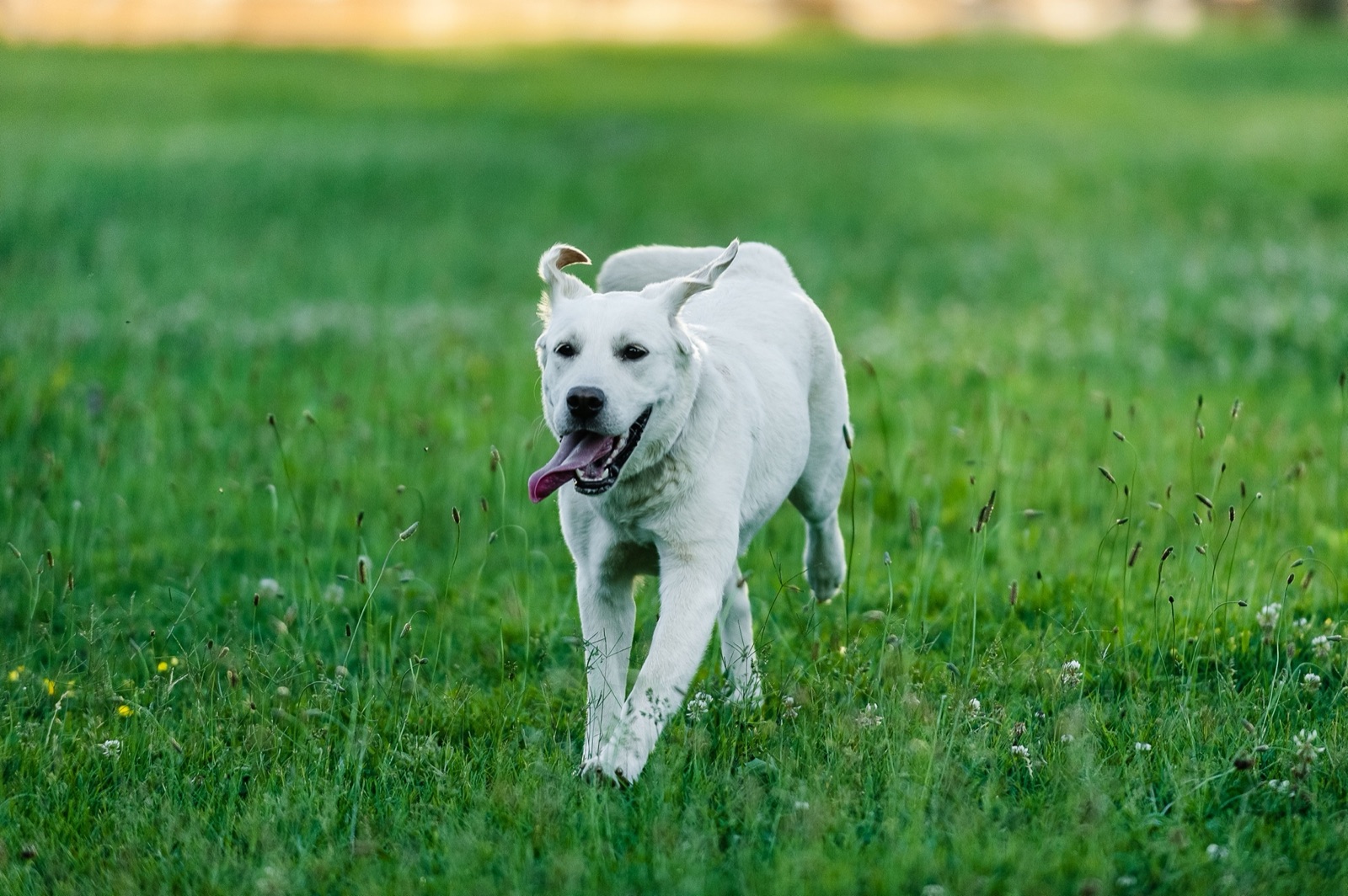
Labrador weight is easy to get wrong in both directions: a scale number that looks normal can hide a dog carrying too much fat, and a big-boned Lab can be lean at a weight that sounds high. By the end of this guide you will know the breed's normal range, how to score your Lab's body condition with your hands and eyes, why Labs gain weight so easily, and what the research says lean Labs gain from it.
Labrador weight: what the breed standard says
The AKC breed standard gives approximate weights in working condition of 65 to 80 pounds for males and 55 to 70 pounds for females, with males standing 22½ to 24½ inches at the shoulder and females 21½ to 23½ inches. The AKC's breed overview gives the overall range as 55 to 80 pounds depending on sex. The standard also says Labs should be "well-muscled and without excess fat."
That range is wide because Labs differ in height and build. A tall male can be lean at 80 pounds, and a small female can be overweight at 65. This is why vets judge weight with a body condition score rather than the scale alone. Coat color plays no part: the standard sets weights by sex, not by black, yellow or chocolate.
How to score your Lab's body condition
The WSAVA Global Nutrition Committee publishes a 9-point body condition chart. Scores 4 and 5 are ideal, 1 to 3 are under ideal and 6 to 9 are over ideal.
Step 1: Feel the ribs
Run your flat hands along both sides of the chest. In WSAVA's description, at an ideal score the ribs are easy to feel with minimal fat covering (score 4), or can be felt without excess fat (score 5). At score 6 you feel them under a slight excess of fat; at 7 only with difficulty under heavy fat.
Labs have a dense double coat, so a Lab can look trim in photos while the ribs are hard to find. Always check by touch.
Step 2: Look from above
Stand over your Lab while it stands. At an ideal score, a waist is easily noted or observed behind the ribs. At 6 the waist is visible but not prominent; at 7 it is absent or barely visible; at 8 and 9 it is gone.
Step 3: Look from the side
At an ideal score the belly tucks up behind the ribs. At 8 there is no tuck, and at 9 the belly is obviously distended.
Step 4: Check the base of the tail and the back
Fat deposits over the lower back and at the base of the tail are part of WSAVA's description of scores 7 to 9. They are easy to feel on a Lab's thick tail base.
The chart at a glance
| Score | What WSAVA describes |
|---|---|
| 1–3 (under ideal) | Ribs, spine or hip bones easy to see; little or no fat to feel |
| 4–5 (ideal) | Ribs easy to feel with little fat; waist visible from above; belly tucked up from the side |
| 6 | Ribs felt with slight excess fat; waist visible but not prominent; belly still tucks up |
| 7 | Ribs hard to feel under heavy fat; fat over the lower back and tail base; waist barely visible |
| 8–9 | Ribs not felt without firm pressure, or not at all; no waist or tuck; heavy fat deposits, belly distended |
When to see your vet about weight
Book a visit if your Lab scores 6 or higher, scores 3 or lower, or gains or loses weight without a change in food or exercise. Your vet can confirm the score, rule out medical causes and set a target weight.

Why Labs gain weight so easily
The POMC gene and appetite
In 2016, researchers led by Eleanor Raffan at the University of Cambridge reported in Cell Metabolism a 14-base-pair deletion in the POMC gene in Labrador Retrievers. It was associated with higher body weight, more body fat and greater food motivation, and it was more common in Labs selected to become assistance dogs than in pets. Cambridge reported that about 23% of the Labradors studied carried at least one copy and that each copy was linked to an average of about 1.9 kg (about 4.2 lb) more body weight. Among other breeds tested, the deletion turned up only in the closely related Flat-Coated Retriever.
A later Cambridge study found that dogs with the variant are hungrier between meals and need fewer calories, which the lead researcher called a "double whammy." She also said, "It's very difficult to keep these dogs slim, but it can be done."
How common overweight Labs are
In a UK study of more than 2,000 Labradors seen by primary-care vets, overweight or obesity was the second most common recorded disorder, at 8.8%. Neutered males were recorded as overweight more often than entire males (11.4% against 4.1%). The figure depends on vets writing a weight problem into the record, so it shows what was noted, not every overweight Lab.
What staying lean gives a Lab
The clearest evidence comes from a lifetime study of 48 Labrador Retrievers, funded by Nestlé Purina and summarized by Lawler and colleagues in the British Journal of Nutrition in 2008. The dogs were paired within litters, and one dog in each pair was fed 25% less than its pair-mate.
- Body condition: between ages 6 and 12, the restricted dogs averaged a body condition score of 4.6 on the 9-point scale; their pair-mates averaged 6.7.
- Lifespan: median lifespan was 13.0 years for the leaner dogs and 11.2 years for their pair-mates.
- Joints: hip osteoarthritis on X-rays was far less common in the leaner group at every age reported, for example 13% against 52% at age 5.
- Chronic disease: the median age at which long-term treatment for any chronic condition began was 12.0 years in the leaner dogs and 9.9 years in their pair-mates.
The pair-mates in that study were not grossly obese; they averaged a 6.7, a score many owners would call "a little chunky." That is the practical lesson for Lab owners.
How to bring your Lab back to a healthy weight
- Ask your vet for a target. A target body condition score and weight, and a check that nothing medical is going on.
- Measure every meal. Feed from the calorie statement on your food and adjust in small steps. Our guide on how much to feed a Labrador walks through it.
- Count treats. The AKC's guideline is that treats make up no more than 10% of your dog's daily calories, including training treats and table scraps.
- Make food last longer. The Cambridge researchers suggest spreading the day's food out, for example with puzzle feeders or scattering it so it takes longer to eat.
- Recheck the score. Feel the ribs and look for the waist regularly, and weigh on the same scale each time.
Common mistakes
- Judging by the scale alone, without feeling the ribs.
- Feeding the bag's amount without checking the dog.
- Forgetting that chews, table scraps and training treats are calories.
- Cutting food sharply without your vet; weight loss should be planned, especially for an older Lab.
Choosing a food with a clear calorie statement helps; see best food for Labradors. How weight fits into a long life is covered in Labrador lifespan. More guides are in the food section.
Questions
How much should a Labrador weigh?
The AKC breed standard gives approximate weights of 65 to 80 pounds for males and 55 to 70 pounds for females in working condition. The right weight for your Lab is the one at which it scores 4 or 5 on the 9-point body condition chart.
How do I know if my Lab is overweight?
On the WSAVA 9-point chart, a dog is over ideal (score 6 or more) when its ribs are felt under extra fat and the waist seen from above is no longer clear; by 7, fat shows over the lower back and tail base and the waist is barely visible. At 6 or more, talk to your vet about a plan.
Why are Labradors always hungry?
A 2016 Cambridge study found a deletion in the POMC gene, carried by about 23% of the Labradors studied, that is linked to greater food motivation and higher body weight. Dogs with it are not greedy by choice, but they still depend on you to control portions.
Does staying lean help a Lab live longer?
In a lifetime study of 48 Labrador Retrievers, dogs fed 25% less than their pair-mates stayed leaner and had a median lifespan of 13.0 years compared with 11.2 years, with later onset of chronic disease such as osteoarthritis.
Do black, yellow and chocolate Labs have different ideal weights?
No. The breed standard sets one weight range by sex, not by color, and the body condition chart works the same way for every coat color.
Sources
- American Kennel Club — Official Standard for the Labrador Retriever
- WSAVA Global Nutrition Committee — Body Condition Score (dog)
- Lawler D.F. et al. (2008) — Diet restriction and ageing in the dog: major observations over two decades, British Journal of Nutrition 99(4):793–805
- Raffan E. et al. (2016) — A Deletion in the Canine POMC Gene Is Associated with Weight and Appetite in Obesity-Prone Labrador Retriever Dogs, Cell Metabolism 23(5):893–900
- University of Cambridge — Genetic variant may help explain why Labradors are prone to obesity (2016)
- University of Cambridge — A quarter of Labradors are hard-wired for obesity
- McGreevy P.D. et al. (2018) — Labrador retrievers under primary veterinary care in the UK: demography, mortality and disorders, Canine Genetics and Epidemiology 5:8
- American Kennel Club — Is the Labrador Retriever the Right Dog Breed for You?
- American Kennel Club — How Many Treats Can Your Dog Have?
More in Food

Guide
How much to feed a Labrador: start with the label, adjust by body
No single cup number fits every Lab. Start from your food's label, measure every meal, then let your dog's shape tell you whether to feed more or less.
Guide in Activity
How much exercise does a Lab need? Adults, puppies and seniors
A healthy adult Lab needs a lot of daily exercise, a puppy needs short sessions and plenty of rest, and every Lab needs work for its brain too.

Guide in Health
Labrador lifespan: how long Labs live and what you can influence
Many Labs live into their early teens. Studies show what tends to shorten that, and a few things you control make a measurable difference.