Guide
How much to feed a Labrador: start with the label, adjust by body
No single cup number fits every Lab. Start from your food's label, measure every meal, then let your dog's shape tell you whether to feed more or less.
Published
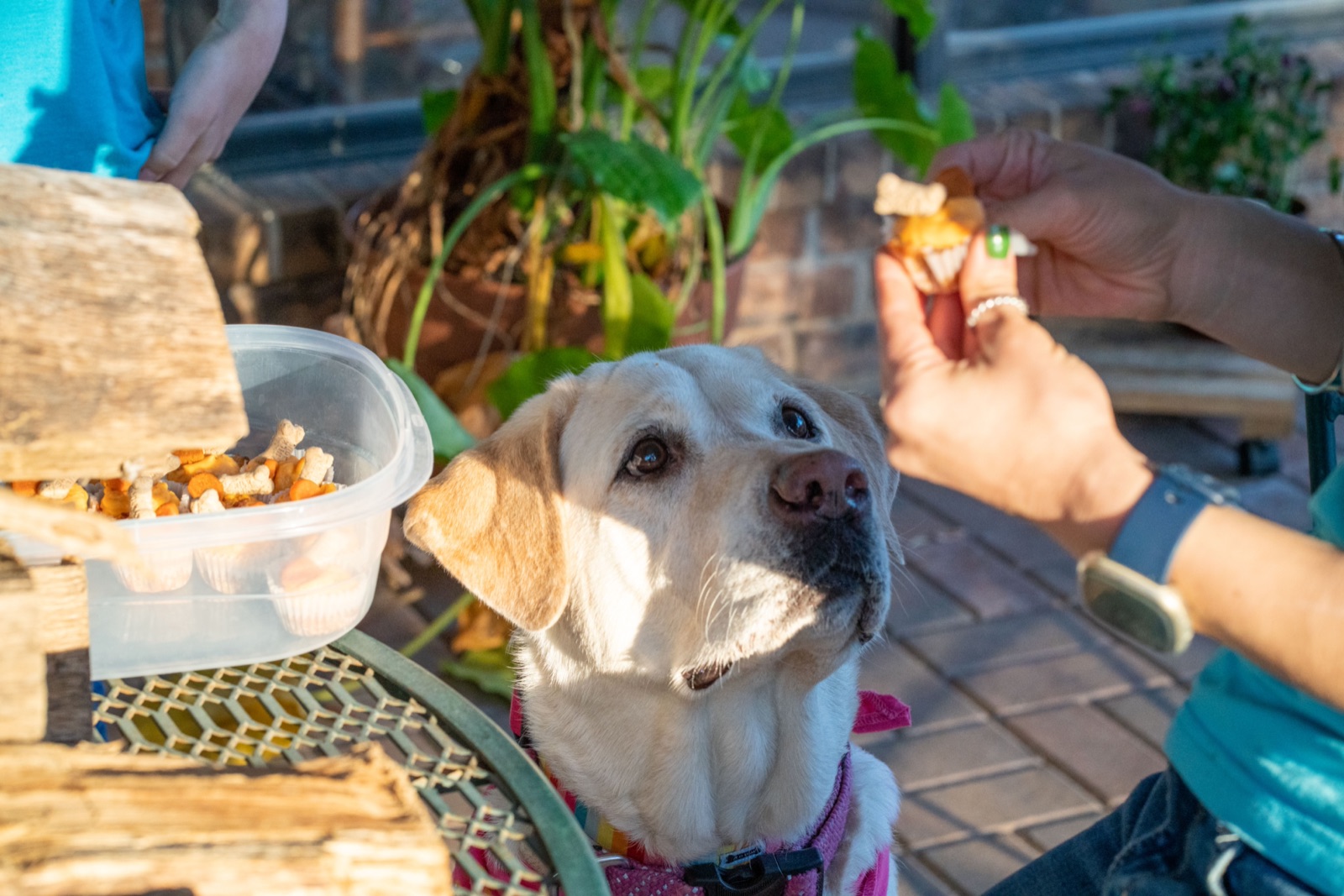
How much to feed a Labrador depends on the food in the bowl and the dog in front of it, so no single number of cups is right for every Lab. Foods differ in calories per cup, and Labs differ in size, age and activity. What works is a simple routine: start from your food's label, measure every meal, check your Lab's body condition, and adjust. By the end of this guide you will have a starting amount, a meal schedule for a puppy or an adult, and a way to tell when to change it.
What you'll need
Essentials
-
Measuring cup that matches the label
: feeding directions and calorie statements are given per cup, so measure with an actual cup, not a guess or a random scoop. -
Your food's calorie statement
: the "Calorie Content" line on the bag or can (kcal per cup or can) is what you portion from. -
A notebook or phone note
: record the daily amount, your dog's weight and body condition score so each adjustment is based on numbers.
Optional
-
Puzzle feeder or slow feeder
: makes a meal last longer for a food-driven Lab without adding calories.
How much to feed a Labrador: why portions matter more
Labs are famously keen on food. A 2016 study in Cell Metabolism linked a deletion in the POMC gene, found in Labradors, to greater food motivation and higher body weight. Cambridge researchers later found that dogs with it are hungrier between meals while needing fewer calories. So a Lab that acts starving is not a reliable gauge of how much it needs.
The stakes are real. In a UK study of Labradors under veterinary care, overweight or obesity was the second most common recorded disorder. And in a lifetime study of 48 Labradors, dogs fed 25% less than their pair-mates stayed leaner and lived longer, with a median lifespan of 13.0 years against 11.2. You can read more in our guide to a healthy Labrador weight.
Step 1: Find your food's numbers
Two lines on the label do most of the work.
The calorie statement
AAFCO requires a "Calorie Content" statement giving kilocalories per kilogram and per familiar unit, such as a cup or can. This is how you compare foods and how you know what one cup actually delivers. WSAVA notes that knowing calorie content helps prevent unintended overfeeding.
The feeding directions
Complete and balanced foods must give feeding directions: how much to feed per unit of body weight, over a set time, for the dog's life stage. AAFCO adds that "feeding directions are guidelines that may need modification to meet a particular pet's needs." They are a starting point, not a target.
Why the calorie number changes the cups
Suppose two foods both suggest about the same daily calories for your Lab's weight, but one has fewer calories per cup than the other. The less dense food needs more cups for the same calories. Moving your Lab from one to the other at the same number of cups would quietly underfeed or overfeed it. That is why this guide never gives a single cup figure: the same amount in cups is a different meal in a different bag. Always recalculate when the food changes.
Step 2: Pick the weight to feed for
Feeding directions are listed by weight. If your Lab is at an ideal body condition, use its current weight. If it is overweight or underweight, ask your vet for a target weight and which amount to start from; that is safer than guessing, especially for a large weight change.
Body condition, not the scale alone, tells you whether the current weight is right. On the WSAVA 9-point chart, scores 4 and 5 are ideal: ribs easy to feel with little fat over them, a waist visible from above and a belly that tucks up when seen from the side.
Step 3: Set the meal schedule
Lab puppies
The AKC suggests:
| Age | Meals a day |
|---|---|
| 6 to 12 weeks | 4 |
| About 3 to 6 months | 3 |
| From about 6 months | 2 |
Feed a measured amount of a complete and balanced growth food at each meal, and do not leave food down for more than 15 minutes. For a Lab puppy, that should be a growth food labeled for large size dogs; see large breed puppy food.
Puppy amounts change fast
Puppies grow quickly, so the label amount moves with them. The AKC suggests weighing your puppy weekly, comparing against breed-appropriate charts and adjusting food so growth stays steady. "Watch the dog, not the dish," as the AKC puts it: body condition, not what is left in the bowl, decides the portion.
Adult Labs
The AKC suggests splitting an adult dog's daily amount into two meals. Measured meals at set times also make it obvious when your Lab skips one, which is worth noting and, if it continues, a call to your vet.
Step 4: Measure every meal
Use a real measuring cup, level, every time, so that "one cup" means the same thing every day. Everyone in the house should use the same measure and know the daily amount, because extra handfuls from different people add up fast with a dog that always asks.

Step 5: Count treats in the daily budget
The AKC's guideline is that treats make up no more than 10% of your dog's daily diet, counted in calories, and that the 10% includes training treats and table scraps. WSAVA uses the same 10% line for foods labeled for intermittent or complementary feeding. In practice:
- Keep training treats as small as possible.
- Take some of the day's kibble for training rewards instead of extra treats.
- Reduce meals slightly on days with many treats or chews.
- Count table scraps and chews as treats.
Step 6: Check and adjust
Read the body, then change the amount
Every week for a puppy, and regularly for an adult, feel the ribs, look for the waist from above and the tuck from the side, and weigh your Lab on the same scale.
- Ideal (score 4–5): keep the amount the same.
- Heading over ideal (score 6 or more): reduce the daily amount a little, check that treats are within budget, and recheck. Ask your vet for a plan if the score does not move.
- Under ideal (score 3 or less): increase a little and recheck, and see your vet, since unexplained weight loss needs a check.
Make one change at a time so you can see what it did.
When the amount should change
- After spaying or neutering. The AKC notes that altering slightly lowers energy needs. In the UK study, neutered male Labs were recorded as overweight more often than entire males.
- Moving from puppy to adult food. The AKC says large breeds usually switch at around 12 to 14 months. A new food has a new calorie count, so recalculate from its label.
- Changes in activity. A Lab that swims and hikes all summer and lounges all winter will not need the same amount in both seasons; let body condition guide you.
- Older age. Keep checking the score as your Lab ages; changes in appetite or weight are worth raising with your vet.
Common mistakes
- Feeding the label amount forever without checking the dog.
- Scooping with a container that is not a measuring cup.
- Treating begging as a sign of hunger.
- Free-feeding a Lab by leaving the bowl full.
- Switching foods without recalculating from the new calorie statement.
When to call your vet
Call your vet if your Lab stops eating for more than a meal or two, or loses or gains weight without a change in food or exercise. If your Lab breaks into the food bin and eats a large amount, or seems in pain or collapses, call your vet or an emergency clinic now.
For choosing the food itself, see best food for Labradors. More guides are in the food section and the puppy section.
Questions
How much should I feed my Labrador per day?
Start with the feeding directions on your food for your Lab's target weight and life stage, then adjust by body condition. AAFCO says those directions are guidelines that may need changing for an individual dog, so no single cup number is right for every Lab.
How much should a Lab puppy eat?
Feed a large-breed growth food by its label for your puppy's age and weight, split into four meals a day from 6 to 12 weeks, three from about 3 to 6 months and two after that, as the AKC suggests. Weigh weekly and adjust so growth stays steady and the puppy stays lean.
How many treats can a Labrador have?
Keep treats, chews and table scraps to no more than about 10% of daily calories, the guideline the AKC gives, and feed the rest as complete meals. Training treats count too.
How often should I feed an adult Lab?
The AKC suggests splitting an adult dog's daily amount into two meals. Two measured meals also make it easier to see if your Lab stops eating, which is worth a call to your vet.
Why does my Lab act hungry all the time?
Many Labs are strongly food-motivated, and a 2016 study linked a POMC gene deletion in the breed to greater food motivation and higher weight. Acting hungry does not mean your Lab needs more food; its body condition score tells you that.
Sources
- AAFCO — Reading Labels
- WSAVA Global Nutrition Committee — Guidelines on Selecting Pet Foods (2021)
- WSAVA Global Nutrition Committee — Body Condition Score (dog)
- American Kennel Club — Puppy Feeding Fundamentals
- American Kennel Club — How Many Treats Can Your Dog Have?
- Raffan E. et al. (2016) — A Deletion in the Canine POMC Gene Is Associated with Weight and Appetite in Obesity-Prone Labrador Retriever Dogs, Cell Metabolism 23(5)
- University of Cambridge — A quarter of Labradors are hard-wired for obesity
- McGreevy P.D. et al. (2018) — Labrador retrievers under primary veterinary care in the UK: demography, mortality and disorders, Canine Genetics and Epidemiology 5:8
- Lawler D.F. et al. (2008) — Diet restriction and ageing in the dog: major observations over two decades, British Journal of Nutrition 99(4):793–805
More in Food
Guide
Labrador weight: how to tell if your Lab is at a healthy weight
The number on the scale is only half the answer. Your hands and eyes, using a 9-point body condition chart, tell you whether that number is right for your Lab.
Guide in Activity
How much exercise does a Lab need? Adults, puppies and seniors
A healthy adult Lab needs a lot of daily exercise, a puppy needs short sessions and plenty of rest, and every Lab needs work for its brain too.

Buying guide
Best food for Labradors: how to choose a food that fits your Lab
There is no single best bag. There is a food that is complete, matches your Lab's life stage and has a calorie count you can actually control.