Guide
How much exercise does a Lab need? Adults, puppies and seniors
A healthy adult Lab needs a lot of daily exercise, a puppy needs short sessions and plenty of rest, and every Lab needs work for its brain too.
Published
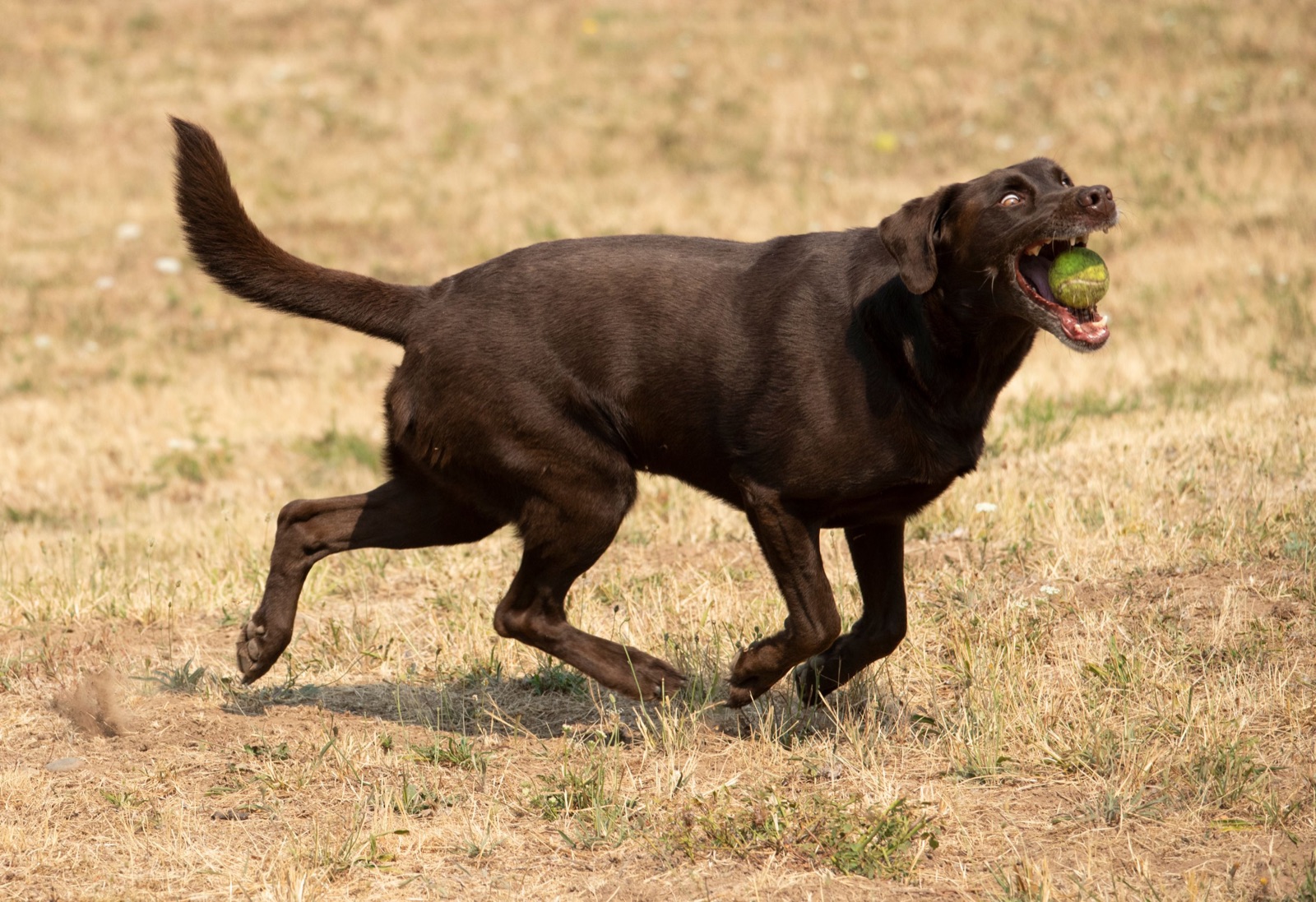
How much exercise does a Lab need? A healthy adult Labrador needs more than two hours a day, according to the Royal Kennel Club, while a puppy needs short sessions and lots of rest, and a senior needs gentler work adjusted to its joints. This guide gives you a plan for each life stage, ideas for exercising your Lab's brain, and the warning signs to watch for in heat and during hard play.
What you'll need
Essentials
-
Collar or harness and a standard leash
: for everyday walks, the base of a Lab's exercise. -
Water and a collapsible bowl
: offer drinks often on outings, especially in warm weather. -
Fetch toys
: retrieving is what Labs were bred for and a good way to burn energy.
Optional
-
Long line, about 15 feet
: lets a young puppy explore at its own pace where there is no fenced yard. -
Puzzle toy or snuffle mat
: mental exercise on rainy or hot days. -
Dog life vest
: for swimming, especially in deep water.
Why Labs need so much exercise
The Labrador is a gundog, bred to retrieve, and the Royal Kennel Club puts the breed's exercise needs in its top band: more than two hours a day. The AKC notes that high-energy breeds need a lot more exercise than lower-energy ones, and that exercise also gives dogs mental stimulation and lowers the risk of obesity.
For a Lab, that matters twice over: it is a large, active breed, so an under-exercised Lab has a lot of energy with nowhere to go, and regular exercise, alongside measured meals, is one of the ways to keep it at a healthy weight.
How much exercise an adult Lab needs
What "more than two hours" can look like
You don't need two hours of running. Split the day into several kinds of activity:
- Walks, on leash, morning and evening, with time to sniff.
- Off-leash running in a fenced or safe area, where your Lab can go at full speed.
- Fetch and retrieving games, on land or in water. Retrieving is the job Labs were bred for.
- Swimming, if your Lab enjoys it. The AKC calls swimming easy on the joints and suggests a life vest, especially in deep water.
- Training and brain games, which count too (more below).
Adjust to your dog. The AKC's advice is that you know your dog best: a young, fit Lab may want more, and a heavier or less fit one needs to build up slowly. Talk to your vet before starting a new, harder exercise program.

Too much or too little
There is no exact number of minutes that fits every Lab. Watch how your dog copes: the AKC's advice for older dogs, to cut back if your dog seems stiff after a walk and to stop anything that looks painful, is a good rule at any age. If your Lab is still restless after a full day of activity, add training and brain games before adding more miles.
Lab puppies: little and often
The five-minute rule
The Royal Kennel Club's rule of thumb is five minutes of formal exercise per month of age, up to twice a day, until the puppy is fully grown: about 15 minutes at three months and 20 minutes at four months. The AKC cites the same guideline from veterinary researchers. The Royal Kennel Club adds that every dog is different and that puppies cope with more as they get older.
"Formal exercise" means structured walks. Free play at the puppy's own pace is separate: the AKC calls free running in a safe, fenced area "the best exercise for puppies," because they set their own pace and rest when they need to. Without a fenced yard, a long line of about 15 feet lets a young puppy explore.
Why puppies need limits
The AKC explains that the soft plates on a puppy's bones need time to harden, and that too much sustained, vigorous exercise before maturity may lead to musculoskeletal problems later, and it warns against constant running on hard surfaces. For that reason the AKC advises:
- No jogging or running on leash with your puppy until it is mature: for large breeds like the Lab, that's usually 12 to 18 months.
- Limit repeated jumping, such as catching balls thrown straight up or dock diving, until full maturity.
- Walk on grass or packed sand rather than concrete, and wait at least an hour after a meal.
Signs a puppy has had enough
The AKC lists sitting down or struggling to keep up as signs of fatigue. Stop, let your puppy rest, and carry it home if you need to.

Senior Labs: keep moving, gently
The AKC is clear that a senior dog still needs exercise. What changes is the kind and the amount:
- Walking is an excellent low-impact exercise; keep the pace comfortable.
- Swimming is easy on the joints, with a life vest for safety.
- Shorter outings if your Lab seems stiff after a walk.
- Soft surfaces: asphalt and gravel can hurt paw pads, especially in warm weather; grass and sand are kinder.
- Temperature care: older dogs are more sensitive to heat and cold.
Talk to your vet before starting new activities, especially if your Lab has arthritis, hip dysplasia or an injury, and stop any activity that seems painful or too hard.
Exercise for the brain
The AKC puts it simply: mental exercise is just as important as physical exercise. Training challenges your dog, and brain games burn energy too. Good options for a Lab:
- Scent games. Hide treats in a snuffle mat or around a room, or play hide and seek so your Lab finds you by smell.
- Puzzle toys that make your Lab work for food; you can use part of the daily meal.
- New tricks and short training sessions, at any age.
- New walking routes. The Royal Kennel Club notes that exercise in unfamiliar places is a good way to provide mental stimulation.
These are especially useful on days when heat, rain or a recovering injury keeps you indoors.
Safety: heat and hard play
Hot weather
A Lab that is busy retrieving won't always stop on its own, so heat safety is your job. Cornell's Riney Canine Health Center advises:
- Walk in the early morning or evening; the hottest part of the day is usually late afternoon, around 3–5 p.m.
- Test the pavement: if you can't keep your hand or bare foot on it for about 10 seconds, it's too hot for your dog.
- Bring water and offer it often.
- Take extra care with dogs that are overweight, elderly, have heart or breathing conditions, or have thick or dark coats, which includes a black or chocolate Lab.
Early signs of overheating include heavy panting, seeking shade, whining, reluctance to play and drooling. If your dog has difficulty breathing, vomits, has bloody diarrhea, is weak or confused, has a seizure or collapses, it may be heatstroke: move your dog somewhere cool, wet the coat down to the skin, and call your vet or an emergency clinic now.
Know the signs of exercise-induced collapse
Exercise-induced collapse (EIC) is an inherited condition that occurs in several breeds, including Labrador Retrievers. The University of Saskatchewan's Veterinary Medical Centre calls it the most common reason for exercise-induced collapse in Labs that otherwise seem healthy. Signs usually appear between five months and three years of age, most often during continuous intense exercise with a lot of excitement, such as repetitive retrieving. The hind legs weaken first, and the dog may keep moving while dragging its back legs.
The centre's advice is to stop exercise immediately at the first hint of wobbliness or incoordination. If your Lab collapses, call your vet or an emergency clinic now. Any Lab that collapses or wobbles during exercise needs a full veterinary checkup, because other conditions, including heart problems and low blood sugar, can look similar. If you have concerns about EIC, talk to your vet; a DNA test exists for it.
Common mistakes
- Weekend-only exercise. A Lab needs daily activity, not a long hike once a week.
- Long runs with a young puppy. Wait until your Lab is mature before jogging together.
- Endless fetch in the heat. Keep retrieving sessions short in warm weather and watch for wobbling or heavy panting.
- Forgetting the brain. Two hours of walking with no training or sniffing leaves a smart dog under-used.
For more ideas, browse the activity section, and for growing dogs, the puppy section.
Questions
How much exercise does an adult Labrador need?
The Royal Kennel Club lists the Labrador as needing more than 2 hours of exercise a day. Split it into walks, off-leash running where it's safe, fetch and swimming, plus training and brain games.
How much exercise does a Lab puppy need?
A common rule of thumb from the Royal Kennel Club is five minutes of formal exercise per month of age, up to twice a day, until the puppy is fully grown. Free play at the puppy's own pace and plenty of rest matter too.
How far should I walk a Labrador puppy?
Think in minutes, not miles: about five minutes per month of age per walk, once or twice a day, on grass or other soft ground. Hold off on jogging with a large-breed puppy until it is mature, usually 12 to 18 months.
Do Labradors need a lot of exercise?
Yes. Labs are a high-energy gundog breed, and the Royal Kennel Club puts their needs at more than 2 hours a day for an adult. Mental exercise such as training and scent games is part of that.
Sources
- The Royal Kennel Club — Retriever (Labrador) breed information
- The Royal Kennel Club — Dog walking
- American Kennel Club — How Much Exercise Does a Puppy Need?
- American Kennel Club — How Much Exercise Does My Dog Need?
- American Kennel Club — How to Provide Your Senior Dog With Proper Exercise
- American Kennel Club — How to Keep Your Dog Mentally Stimulated
- Cornell Richard P. Riney Canine Health Center — Summer heat safety tips for dogs
- University of Saskatchewan Veterinary Medical Centre — Exercise-Induced Collapse (EIC)
More in Activity
Guide in Food
Labrador weight: how to tell if your Lab is at a healthy weight
The number on the scale is only half the answer. Your hands and eyes, using a 9-point body condition chart, tell you whether that number is right for your Lab.
Buying guide in Gear
Harness for a Labrador: front-clip, back-clip or dual, and how to fit it
A well-fitted harness takes the pressure off your Lab's neck. The clip position decides how much help it gives you with pulling.
Buying guide in Gear
Best toys for a Labrador: retrieving, puzzle, tug, water and chew toys
Labs were bred to carry things in their mouths. Pick toys by job, size them for a big mouth, and put the risky ones away after play.