Buying guide
Large breed puppy food for Labradors: what the label must say
A Lab puppy grows toward an adult weight of 55–80 pounds, and grows rapidly in its first months. The right food keeps that growth steady, not fast.
Published
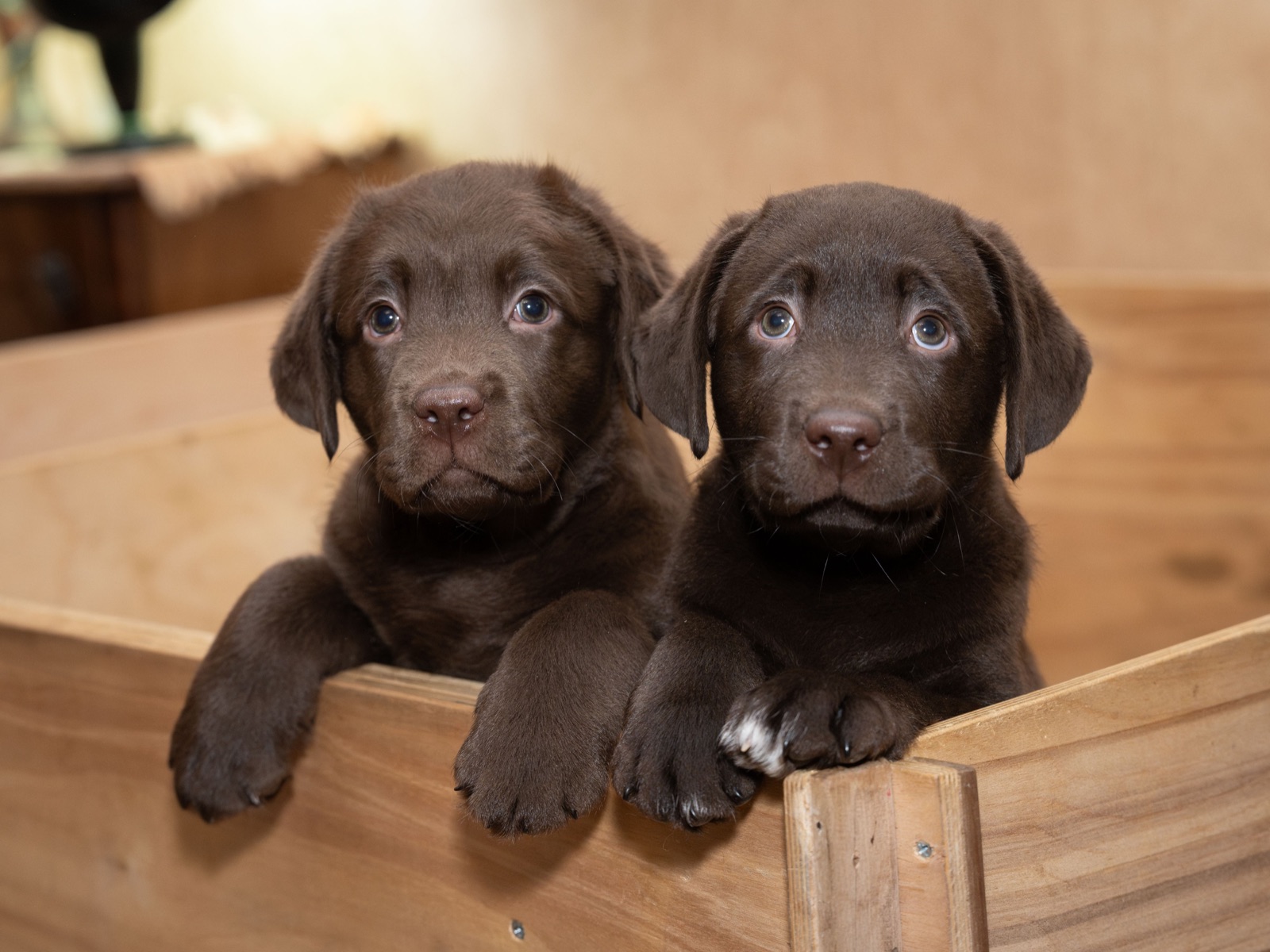
Large breed puppy food is a growth food with tighter limits on calcium and a design that supports steady, not maximal, growth. For a Labrador puppy, choosing one comes down to reading one sentence on the label and then feeding measured amounts. This guide explains what that sentence says, why the limits exist, how the food types compare, and when your Lab should move to adult food.
Why large-breed puppies need different food
The AKC puts it plainly: "Maximal growth is not optimal growth." Puppies grow rapidly from weaning until about 4 to 6 months, and the AKC notes that overfeeding and excessive weight gain in large dogs is a risk factor for developmental orthopedic conditions, including hip dysplasia.
Two things are controlled in a large breed puppy formula:
Calcium
Calcium balanced with phosphorus is "particularly critical for large-breed dogs," according to the AKC, because too much or too little of either can cause skeletal problems. Tufts veterinary nutritionists explain that AAFCO now sets a narrower calcium range for foods meant for large and giant breed puppies, because their developing bones are more sensitive to both excess and shortage.
Calories
Fast growth driven by too many calories is the other risk. Cornell's Riney Canine Health Center describes hip dysplasia as a genetic condition that nutrition and growth rate can modify: overfeeding and rapid growth can worsen it in predisposed puppies, while restricted growth can reduce how much it shows. Cornell advises avoiding overfeeding, "especially in fast-growing puppies of large breeds."
The label sentence to find
Since 2016, AAFCO has required foods labeled for growth or for all life stages to say whether they meet the additional criteria for large-size puppies, as Tufts explains. The statement ends in one of two ways:
- "...including growth of large-size dogs (70 lbs or more as an adult)." This food is formulated for large-breed puppies.
- "...except for growth of large-size dogs (70 lbs or more as an adult)." This food is not meant for large-breed puppies.
The exact punctuation can vary a little from bag to bag (for example "70 lb."); the words "including" and "except for" are what matter.
Tufts warns that the difference is small on the bag but critical, so read the whole sentence, not just the word "puppy" on the front.
Where Labs sit against the 70 lb line
AAFCO's cutoff is an expected adult weight of 70 pounds. The AKC breed standard gives approximate weights of 65 to 80 pounds for males and 55 to 70 pounds for females. So some Labs, especially males, end up above the line, many females end up below it, and plenty are close to it. Tufts also notes that some experts argue for a more conservative 50 lb cutoff.
You cannot know an 8-week-old puppy's adult weight for sure. A food whose statement includes growth of large size dogs suits a Lab puppy whichever side of 70 pounds it lands on, which is why it is the cautious default. The AKC's own advice is that large-breed puppies be fed a growth diet formulated for large-breed puppies for their whole growth period.

Types of food for a Lab puppy compared
| Label or type | Suitable for a Lab puppy? | What to know |
|---|---|---|
| Growth, including large size dogs | Yes | Made for this situation; the usual choice |
| All life stages, including large size dogs | Yes | WSAVA notes all-life-stage foods are formulated for growth and reproduction |
| Growth or all life stages, except for large size dogs | No | Not meant for puppies expected to reach 70 lb or more |
| Adult maintenance | No | Not formulated for growth |
| Dry (kibble) large breed puppy formula | Yes, if the statement fits | Easy to measure and use as training rewards from the daily ration |
| Canned (wet) large breed puppy formula | Yes, if the statement fits | Much more water; compare with dry food on a dry matter basis, as the FDA explains |
Dry and wet foods can both be complete and balanced. What makes one right for a Lab puppy is the large-size growth statement, not the form.
What to look at before you buy
The statement
Check for "including growth of large size dogs." If the statement is not on the bag, the food does not make the claim.
The calorie content
AAFCO requires a "Calorie Content" statement in kilocalories per kilogram and per cup or can. You need it to portion meals and to adjust them as your puppy grows.
The feeding directions
They are required for complete and balanced foods and give amounts by body weight and life stage, but AAFCO says they are guidelines that may need changing for an individual dog. For a puppy, the AKC says portions should follow body condition: "Watch the dog, not the dish."
The company behind it
WSAVA suggests asking whether the maker employs a qualified nutritionist, who formulates the food, what quality control it uses and whether it does research. A company that cannot answer is a reason for caution.
How to feed a large breed puppy food
Meals and portions
The AKC suggests four meals a day from 6 to 12 weeks, then three a day from about 3 to 6 months, then two meals. Give a measured amount at each meal, and do not leave food down for more than 15 minutes.
Treats in a puppy's day
Training treats come out of the same daily budget: the AKC says treats should not exceed 10% of a puppy's daily calories, and training treats count. Keep them small, and take part of each meal for training rewards when you are doing a lot of practice.
Body condition
The AKC says even puppies not predisposed to skeletal problems should be kept lean: ribs easy to feel with minimal fat covering, and an obvious tuck behind the ribs when seen from the side. It also suggests weighing your puppy weekly and adjusting food to keep growth steady, and notes that a puppy should lose its potbelly by about 12 weeks.
No extra calcium
Cornell advises against supplementing growing puppies with calcium, vitamin D or protein beyond what a complete and balanced diet already provides. Adding calcium to a large breed formula undoes the point of the formula.
Exercise during growth
Cornell's panosteitis guidance recommends regular, age-appropriate exercise while limiting repetitive high-impact activity, such as long runs on hard ground, during rapid growth.
Portion sizes and how to adjust them are covered step by step in how much to feed a Labrador.
When to switch to adult food
The AKC says larger breeds usually move to adult food at around 12, 13 or even 14 months, and that keeping a puppy on puppy food a little too long is safer than switching too early. It also notes that spaying or neutering slightly lowers energy needs, so some altered puppies switch within the 6 to 12 month window. Your vet can help you pick the time for your Lab. The AKC also warns that frequently switching foods can create pickiness or obesity, so once you find a food that fits, staying with it is reasonable.
Which option suits whom
- Most Lab puppies: a dry or wet growth food labeled "including growth of large size dogs," fed in measured meals.
- A puppy that is already chunky: the same food, smaller measured portions and a talk with your vet; the label amount is a starting point, not a target.
- A household feeding more than one dog: an all-life-stages food that includes large size growth can work for everyone, as long as you portion each dog's calories separately.
Why steady growth matters for joints is covered in our guide to Labrador hip dysplasia, and choosing an adult food later is covered in best food for Labradors. More puppy guides are in the puppy section.
Questions
Does a Labrador puppy need large breed puppy food?
It is the cautious choice. AAFCO's large-size category covers dogs expected to weigh 70 pounds or more as adults, the Lab breed standard runs up to 80 lb for males, and you cannot know a puppy's adult weight in advance, so a growth food labeled for large size dogs covers the risk.
What should the label say on a large breed puppy food?
Look for an AAFCO statement for growth or all life stages that ends "including growth of large-size dogs (70 lbs or more as an adult)." A statement that says "except for growth of large-size dogs" means the food is not meant for large-breed puppies.
When should a Lab puppy switch to adult food?
The AKC says larger breeds usually move to adult food at around 12 to 14 months and that staying on puppy food a little long is safer than switching early. Spaying or neutering lowers energy needs, so ask your vet whether to switch sooner.
Should I give my Lab puppy calcium supplements?
No, not unless your vet prescribes them. Cornell's Riney Canine Health Center advises against supplementing growing large-breed puppies with calcium or vitamin D beyond what a complete and balanced diet provides.
How many times a day should a Lab puppy eat?
The AKC suggests four meals a day from 6 to 12 weeks, three meals from about 3 to 6 months and two meals after that, using measured portions rather than leaving food out.
Sources
- Tufts Petfoodology (Linder, 2017) — Confused About What to Feed Your Large Breed Puppy? New Rules May Help!
- AAFCO — Reading Labels
- American Kennel Club — Proper Puppy Nutrition Nourishes Rapid Growth
- American Kennel Club — Puppy Feeding Fundamentals
- Cornell Riney Canine Health Center — Canine hip dysplasia (CHD)
- Cornell Riney Canine Health Center — Panosteitis in dogs
- WSAVA Global Nutrition Committee — Guidelines on Selecting Pet Foods (2021)
- U.S. FDA — “Complete and Balanced” Pet Food
- American Kennel Club — Official Standard for the Labrador Retriever
More in Food

Guide in Puppy
Labrador growth chart: typical weight by age and when Labs stop growing
Rough weight ranges by age, why your puppy won't match any single number, and how to track growth with your vet instead.

Buying guide
Best food for Labradors: how to choose a food that fits your Lab
There is no single best bag. There is a food that is complete, matches your Lab's life stage and has a calorie count you can actually control.
Guide in Health
Labrador hip dysplasia: signs, screening and what owners can do
Hip dysplasia is mostly inherited, but growth rate and body weight shape how much it affects a Lab. Here is what to watch for and what to ask a breeder.