Comparison
English vs American Labrador: show and field types of one breed
Not two breeds but two breeding goals: a show ring Lab and a field Lab, measured against the same standard.
Published
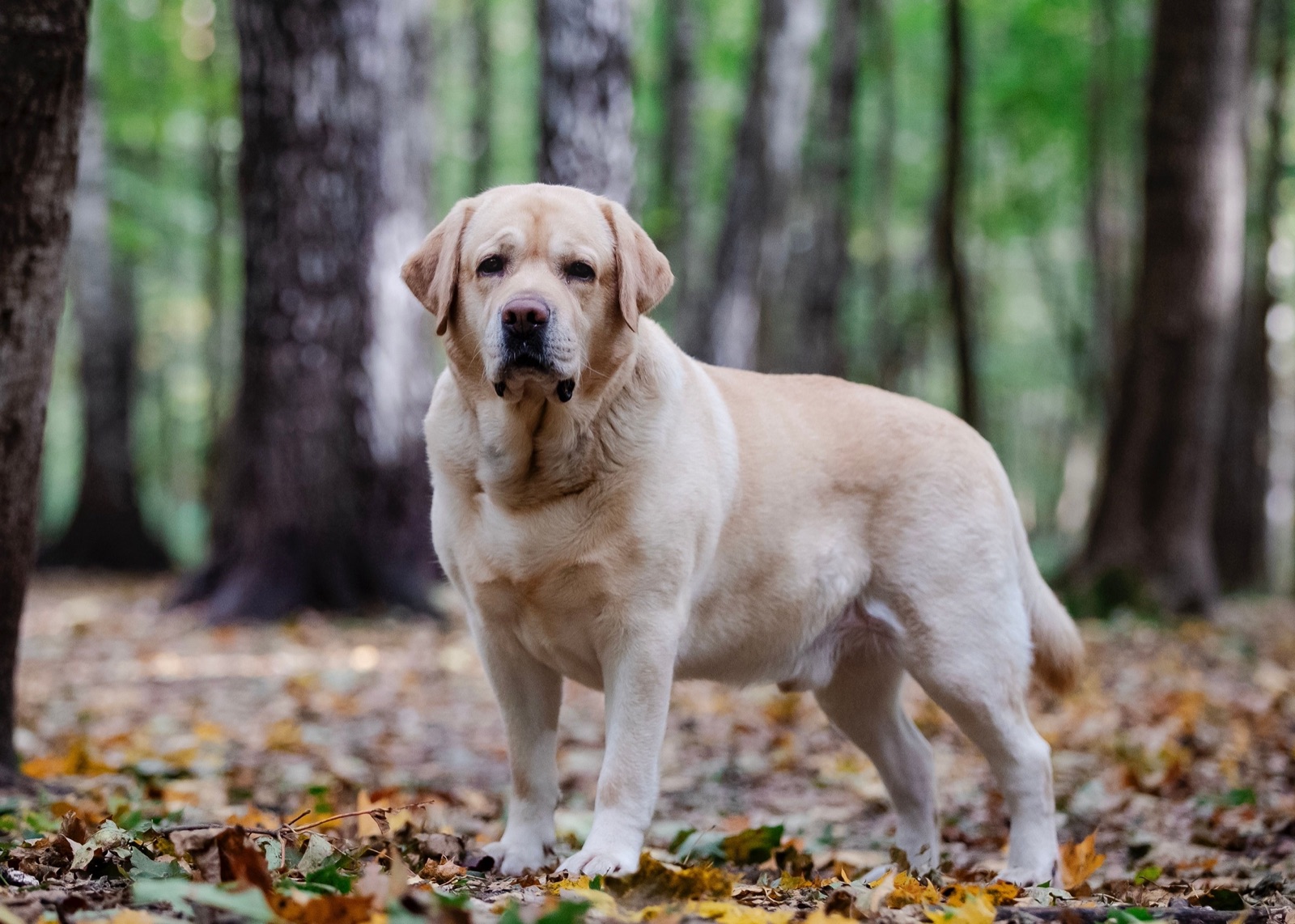
The English vs American Labrador question has a short answer: they are one breed. The AKC registers a single Labrador Retriever and judges every one against the same written standard. "English" is the everyday name for the heavier show type, bred to win in the conformation ring; "American" is the name for the leaner field type, bred to hunt and compete in field trials. The UC Davis Veterinary Genetics Laboratory describes the split as the result of geographical separation, a show versus performance emphasis, and regional differences in how breeders read the standard.
English vs American Labrador at a glance
The labels describe tendencies across breeding lines. Individual dogs overlap, and many pet Labs come from neither a show nor a field line.
| English (show or bench type) | American (field or working type) | |
|---|---|---|
| Bred mainly for | The conformation ring and family life | Hunting, field trials and hunt tests |
| Build | Heavier, broader chest, more substance | Leaner, longer-legged, lighter frame |
| Head | The "blocky" head is more pronounced | Less blocky head |
| Energy | Usually described as calmer | Usually described as more energetic |
| Retrieving drive and trainability | Lower on average in one UK survey | Higher on average in the same survey |
| AKC height | Same standard: 22.5–24.5 in (males), 21.5–23.5 in (females) | Same standard |
| Colors | Black, yellow (cream to fox red), chocolate | Black, yellow (cream to fox red), chocolate |
One breed, one standard
The AKC standard asks a Labrador to have "the substance and soundness to hunt waterfowl or upland game for long hours," "the character and quality to win in the show ring," and "the temperament to be a family companion." It also says plainly that the Labrador "is bred primarily as a working gun dog." So in theory, one dog should do all three.
In practice, UC Davis notes that the AKC and the breed club have set the standard to accommodate differences between field-bred and show-bred Labs "but only to a point," and that dual champions who excel both in the field and in the show ring are increasingly uncommon. Genetic studies back up the split. A 2017 study of UK Labradors found genetic differentiation within the breed linked to the dog's role (working, pet or show), with some of the most different regions near genes linked to skull shape. A 2020 study found Labradors split by both geography and lineage, with show lineages the most differentiated.
What "English" does and doesn't mean
In US puppy ads, "English Labrador" almost always means show type, not a dog born in England. The UK's own breed standard, from the Royal Kennel Club, gives an ideal height of 22 to 22.5 inches for males and 21.5 to 22 inches for females and calls for a dog that is "very agile (which precludes excessive body weight or excessive substance)." Britain also breeds working gundog lines of its own. So a "black English Labrador retriever" or a "chocolate English Labrador" is a show-type Lab of that color, wherever it was bred.
The English (show) Labrador
Show-bred Labs are selected for how closely they match the standard's picture of the breed: the broad back skull, the thick "otter" tail, the dense coat and a sturdy, short-coupled body. UC Davis describes the breed's "blocky" head as more pronounced in English-type dogs.
Build and weight
The measurements so far are thin. A 2025 student degree project at the Swedish University of Agricultural Sciences measured 45 healthy intact male Labradors aged 2 to 6 years: 28 from gundog lines and 17 from show or pet lines. The show-type dogs were significantly heavier, with a larger chest girth and longer body, and more of them were slightly overweight. With so few dogs, the author advises reading the results with caution. That last point matters for you: a heavier frame is not the same as extra fat, and the AKC standard says Labs should be shown "in working condition well-muscled and without excess fat." Keep any Lab lean, whatever its type.
Temperament
Field lines are usually described as the more energetic type, so show lines are the usual pick for a calmer pet. In the 2014 UK owner survey of 1,978 Labradors, show dogs and pets scored lower than gundogs on retrieving drive and trainability, though the study could not separate breeding from how the dogs were trained and kept. A Swedish behavior test study found pet and show-type Labs showed more curiosity than field types.
The American (field) Labrador

Field-bred Labs are selected for work: hunting, field trials and hunt tests, the job the AKC standard calls the breed's primary purpose. UC Davis describes American Labs as "leaner and longer-legged" and more energetic, "having been bred originally to compete in field trials."
Build and weight
Expect a lighter, more athletic dog that may look rangy next to a show Lab. Height should still fall within the same standard. A lighter Lab is not a small Lab; it is a different balance of bone and muscle on a similar frame.
Temperament
Gundogs in the 2014 survey scored higher than show dogs and pets on "fetching tendency" and trainability. That drive is a strength if you hunt, train for hunt tests or run with your dog. It also means a field-bred Lab needs real daily work. The AKC warns that any Lab who doesn't get enough exercise is likely to turn to hyperactive or destructive behavior. See the activity section and the training section for ways to channel it.
Which type should you choose
Choose by your life, not the label.
- You want a family dog for a busy household and moderate exercise: a well-bred show-line Lab is often the easier fit, though it still needs daily exercise and training. Every Lab is a sporting breed.
- You hunt, or want a partner for hunt tests, dock diving, running or long hikes: a field-line Lab bred from working parents will usually bring more drive and stamina.
- You want an active pet but not a working dog: ask breeders about the parents' energy at home.
- You are adopting an adult or a rescue: judge the dog in front of you. Type labels are guesses without a pedigree.
Questions to ask a breeder
About the parents
Ask what the parents do: show titles, field or hunt test titles, or neither. Ask to meet the mother, and the father if possible, and see how they behave at home. Ask what health tests the parents have had; the health section explains the common ones.
About the label
If a seller charges more for an "English" or "American" Lab, ask what the dog's pedigree shows. Both types come in black, yellow and chocolate, and a fox red English Lab is simply a dark yellow show-type dog. Our guide to Labrador colors explains the genetics, and Labrador size covers the height and weight you can expect from either type.
Questions
Is an English Labrador a different breed from an American Labrador?
No. The AKC registers one breed, the Labrador Retriever, judged against one standard. English and American are informal names for dogs bred mainly for the show ring and dogs bred mainly for field work.
Does English Labrador mean the dog comes from England?
Not necessarily. In the US the word usually describes the heavier show type, wherever the dog was born. Both show and field lines are bred in Britain and in North America.
Which is calmer, an English or an American Lab?
Field-bred Labs are usually described as more energetic, because they were bred to compete in field trials. That is a tendency across lines, not a promise about one dog, so meet the parents.
Are English Labs bigger than American Labs?
Show-type Labs are usually heavier and broader, while field Labs tend to be leaner and longer-legged. Both are measured against the same AKC height range of 22.5 to 24.5 inches for males and 21.5 to 23.5 inches for females.
Do English and American Labs come in the same colors?
Yes. Both types come in black, yellow and chocolate, the only colors the breed standard allows. Fox red is a shade of yellow and appears in both.
Sources
- American Kennel Club — Labrador Retriever breed page
- American Kennel Club — Official Standard for the Labrador Retriever (approved 1994)
- The Royal Kennel Club — Retriever (Labrador) breed standard
- UC Davis Veterinary Genetics Laboratory — Genetic Diversity Testing for Labrador Retrievers
- Wahlstam Bredelius (2025), Body measurements, body weight, body condition and degree of hip dysplasia in a cohort of gundog and common Labrador retrievers. Swedish University of Agricultural Sciences (SLU), student degree project, 45 dogs
- Lofgren et al. (2014), Management and personality in Labrador Retriever dogs. Applied Animal Behaviour Science 156
- Sundman et al. (2016), Similar recent selection criteria associated with different behavioural effects in two dog breeds. Genes, Brain and Behavior
- Wiener et al. (2017), Genomic data illuminates demography, genetic structure and selection of a popular dog breed. BMC Genomics
- Lampi et al. (2020), Variation in breeding practices and geographic isolation drive subpopulation differentiation. Canine Medicine and Genetics
More in Breed
Guide
Labrador size: height, weight and growth of males and females
How tall and heavy a full grown Labrador should be, how fast a puppy gets there, and why there is no such thing as a standard mini Lab.
Guide in Training
Labrador temperament: what a Lab's personality is really like
Kind, outgoing and built for work: the Lab personality in the breed standard, what research adds, and what it means at home.
Guide
Black Labrador, yellow and chocolate: the three Lab colors and how they are inherited
Three colors, two genes and a lot of myths: what a Lab's coat color tells you, and what it doesn't.