Guide
Labrador size: height, weight and growth of males and females
How tall and heavy a full grown Labrador should be, how fast a puppy gets there, and why there is no such thing as a standard mini Lab.
Published
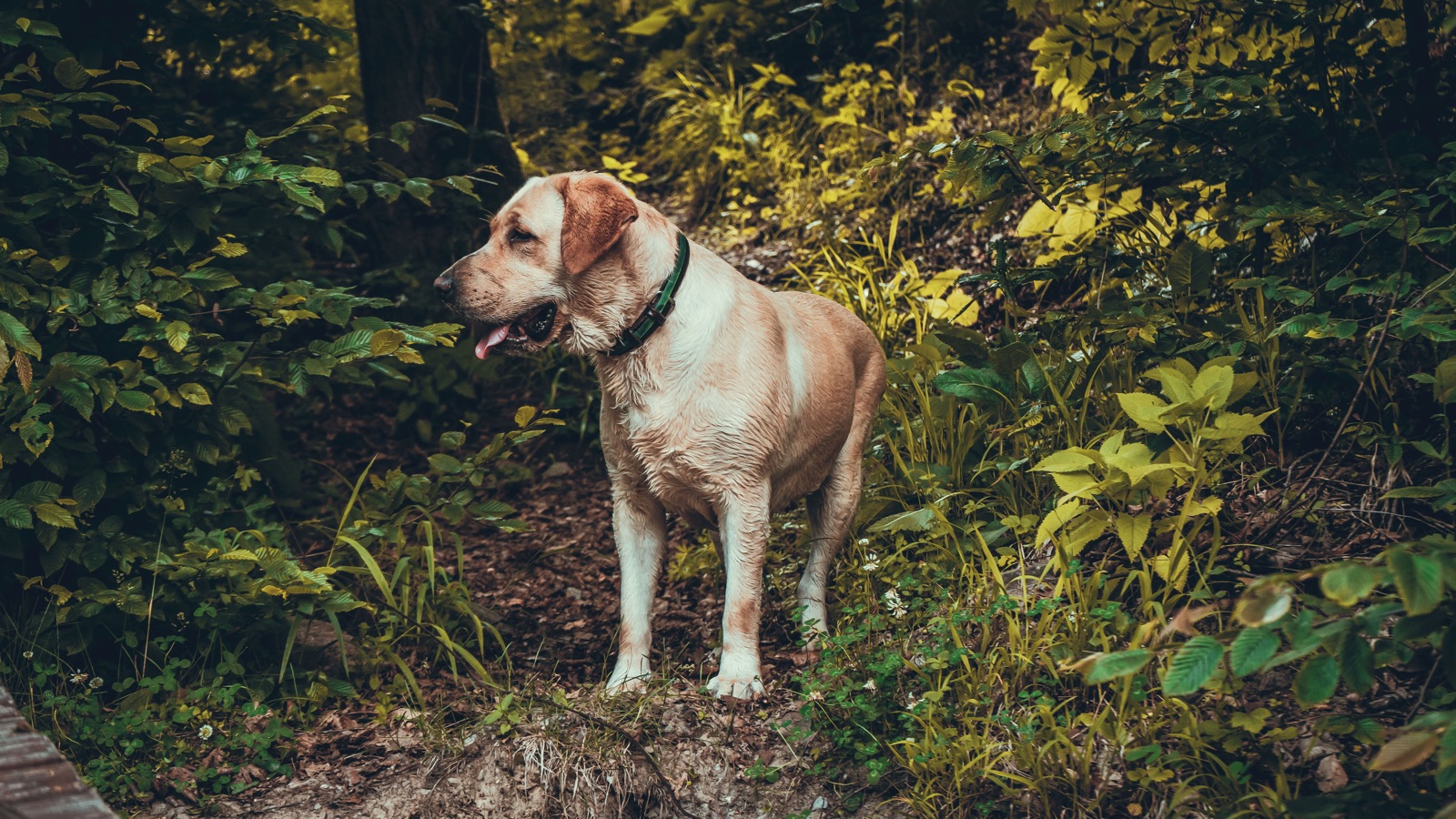
Labrador size is set by the breed standard: a full grown male stands 22.5 to 24.5 inches at the shoulder and weighs about 65 to 80 pounds, and a female stands 21.5 to 23.5 inches and weighs about 55 to 70 pounds. This guide explains those numbers, how real pet Labs compare, how fast a puppy grows into them, and what to make of "mini" and "large" Labs. Use it to plan crate and bed sizes, and to check that your dog is growing and staying in shape.
Labrador size by the breed standard
The AKC describes the Labrador as a "strongly built, medium-sized" dog, and on its breed page as a fit for a family "looking for a medium-to-large dog." The standard gives exact heights and approximate weights.
| Height at the withers | Weight in working condition | |
|---|---|---|
| Male (dog) | 22.5–24.5 in | 65–80 lb |
| Female (bitch) | 21.5–23.5 in | 55–70 lb |
Two details matter. First, height is strict and weight is not. Any adult more than half an inch above or below the height range is disqualified in the AKC show ring, but the weights are labeled "approximate." Second, the weights are for a dog "in working condition": the standard says Labs should be "well-muscled and without excess fat."
The UK's Royal Kennel Club standard is narrower and a little lower: an ideal of 22 to 22.5 inches for males and 21.5 to 22 inches for females.
Proportions, not just numbers
The AKC standard also describes shape. A Lab is "short-coupled": its body from the point of the shoulder to the point of the rump is equal to or slightly longer than its height. The distance from elbow to ground should be half the height at the withers. Light, "weedy" dogs and "cloddy lumbering" ones are both called incorrect. A correct Lab should never look "low and long or tall and leggy."
How to measure your Lab's height
Height is measured at the withers, the top of the shoulder blades. Stand your dog square on level ground, lay a straight edge across the withers parallel to the floor, and measure from the floor to the underside of the straight edge. Measure weight on the same scale each time, ideally at your vet's office.
Males vs females
The standard separates the sexes by about an inch in height and 10 pounds in weight. Real dogs follow the same pattern. In a UK study of more than 33,000 Labradors under veterinary care, adult males averaged 35.2 kg (about 78 pounds) and adult females 30.4 kg (about 67 pounds); the overall average was 33.0 kg (about 73 pounds).
Those averages sit near the top of the standard ranges. Part of that is the population: the same study found overweight or obesity among the most common problems recorded, and neutered males were more often overweight than intact males (11.4% against 4.1%). A heavy average does not mean heavy is normal.
How fast a Lab puppy grows

The AKC's puppy growth chart puts large breeds (51 to 100 pounds as adults), which includes Labs, on this path:
| Age | Share of adult size |
|---|---|
| 6 months | About 60% |
| 9 months | About 75% |
| 12 months | About 85% |
| 15 months | About 95% |
| 18 months | 100% |
So a Lab looks almost adult at a year but is still filling out. The AKC explains that height growth ends when the growth plates in the long bones close, and that a dog keeps building muscle and body fat after that. Bone growth can take anywhere from 6 to 24 months depending on size, and bigger dogs take longer.
What to do while your puppy grows
- Keep the puppy lean. The AKC warns that obesity in puppies can predispose them to orthopedic problems later. Labs make this harder than most breeds: a deletion in the POMC gene, found in about 12% of the Labrador gene pool in one study, is linked to higher body weight and stronger food motivation. The food section covers feeding by age.
- Size gear for the adult. A crate or bed bought for an 8-week-old will be outgrown within months. Buy for the adult dog and use a divider while the puppy is small; the gear section and the puppy section explain how.
- Don't judge a puppy by the standard. The AKC standard says the minimum heights do not apply to dogs under 12 months.
Mini Labs and small Labs
There is no miniature Labrador in the breed standard. A purebred Lab more than half an inch under the height range is disqualified in the show ring, and neither the AKC nor the UK standard describes a small variety. A dog sold as a "mini black Lab" or "chocolate Lab mini" could be one of three things:
- A small individual. Some Labs are simply at or just below the bottom of the height range.
- A mix. A Lab crossed with a smaller breed.
- A dog with a form of dwarfism. Researchers have described a mild, inherited form of disproportionate dwarfism in Labradors, called skeletal dysplasia 2 (SD2), in which the legs are shorter. It is recessive and was found primarily in working lines. The AKC lists it among the genetic variants identified in the breed, and a DNA test exists.
If a breeder advertises miniature Labs as a planned size, ask how the size is produced and ask for DNA results for both parents. There is no "mini retriever" version of the Labrador.
Large Labs
At the other end, the standard's 80 pounds for males is approximate, so a tall, well-muscled male may weigh a little more and still be fit. A "large black Lab" that is heavy because of fat is a different matter. Show-type Labs are often heavier than field types. A 2025 Swedish student project that measured just 45 young males found the show-line dogs heavier, with a larger chest girth and a longer body than gundog-line dogs, and more often slightly overweight; the sample is too small to go further than that. Our English vs American Labrador comparison explains the two types.
Color does not change size. Black, yellow and chocolate Labs are judged against the same height and weight ranges; see Labrador colors.
Signs a Lab is carrying too much weight
Weight on its own is a poor guide, because frame size varies. Your vet will assess body condition by feel and shape, and the health section explains what to watch for. If you are unsure whether your Lab's weight is right, ask your vet at the next visit rather than changing food on your own.
Common mistakes with Lab size
- Treating the top of the range as the goal. The standard values a lean, athletic dog over a big one.
- Comparing a 6-month-old to an adult. At 6 months a Lab is roughly 60% grown.
- Paying extra for a "mini" or "giant" Lab. Neither is a recognized size, and both are worth questioning.
- Buying a puppy-sized crate. You will replace it within months.
Questions
How big does a full grown Labrador get?
By the AKC standard, males stand 22.5 to 24.5 inches at the shoulder and weigh about 65 to 80 pounds; females stand 21.5 to 23.5 inches and weigh about 55 to 70 pounds, in lean working condition.
What is the average size of a Labrador?
In a UK study of Labradors under veterinary care, adult males averaged 35.2 kg (about 78 pounds) and females 30.4 kg (about 67 pounds). Those are real pet dogs, some of them overweight, not the breed standard.
When is a Labrador full grown?
The AKC's growth chart for large breeds shows about 85% of adult size at 12 months and full size around 18 months. Height stops when the growth plates close; muscle and weight can keep filling in after that.
Are mini Labs a real breed?
No. The breed standard has no miniature size and disqualifies a Lab more than half an inch outside its height range. A dog sold as a mini Lab may be a small individual, a mix, or a dog with a short-legged form of dwarfism that has been described in Labradors.
Is my large black Lab overweight?
Weight alone doesn't tell you. A tall, well-muscled male can weigh more than the standard's 80 pounds and still be lean, while a short dog at 75 pounds can be overweight. Ask your vet to check body condition.
Sources
- American Kennel Club — Official Standard for the Labrador Retriever (approved 1994)
- American Kennel Club — Labrador Retriever breed page
- American Kennel Club — Puppy Growth Chart: When Does My Puppy Finish Growing?
- American Kennel Club — Labrador Retriever DNA tests
- The Royal Kennel Club — Retriever (Labrador) breed standard
- McGreevy et al. (2018), Labrador retrievers under primary veterinary care in the UK: demography, mortality and disorders. Canine Genetics and Epidemiology
- Frischknecht et al. (2013), A COL11A2 mutation in Labrador retrievers with mild disproportionate dwarfism. PLoS One
- Raffan et al. (2016), A deletion in the canine POMC gene is associated with weight and appetite in obesity-prone Labrador Retriever dogs. Cell Metabolism
- Wahlstam Bredelius (2025), Body measurements, body weight, body condition and degree of hip dysplasia in a cohort of gundog and common Labrador retrievers. Swedish University of Agricultural Sciences (SLU), student degree project, 45 dogs
More in Breed

Guide in Puppy
Labrador growth chart: typical weight by age and when Labs stop growing
Rough weight ranges by age, why your puppy won't match any single number, and how to track growth with your vet instead.
Guide in Food
Labrador weight: how to tell if your Lab is at a healthy weight
The number on the scale is only half the answer. Your hands and eyes, using a 9-point body condition chart, tell you whether that number is right for your Lab.
Comparison
English vs American Labrador: show and field types of one breed
Not two breeds but two breeding goals: a show ring Lab and a field Lab, measured against the same standard.