Buying guide
Harness for a Labrador: front-clip, back-clip or dual, and how to fit it
A well-fitted harness takes the pressure off your Lab's neck. The clip position decides how much help it gives you with pulling.
Published
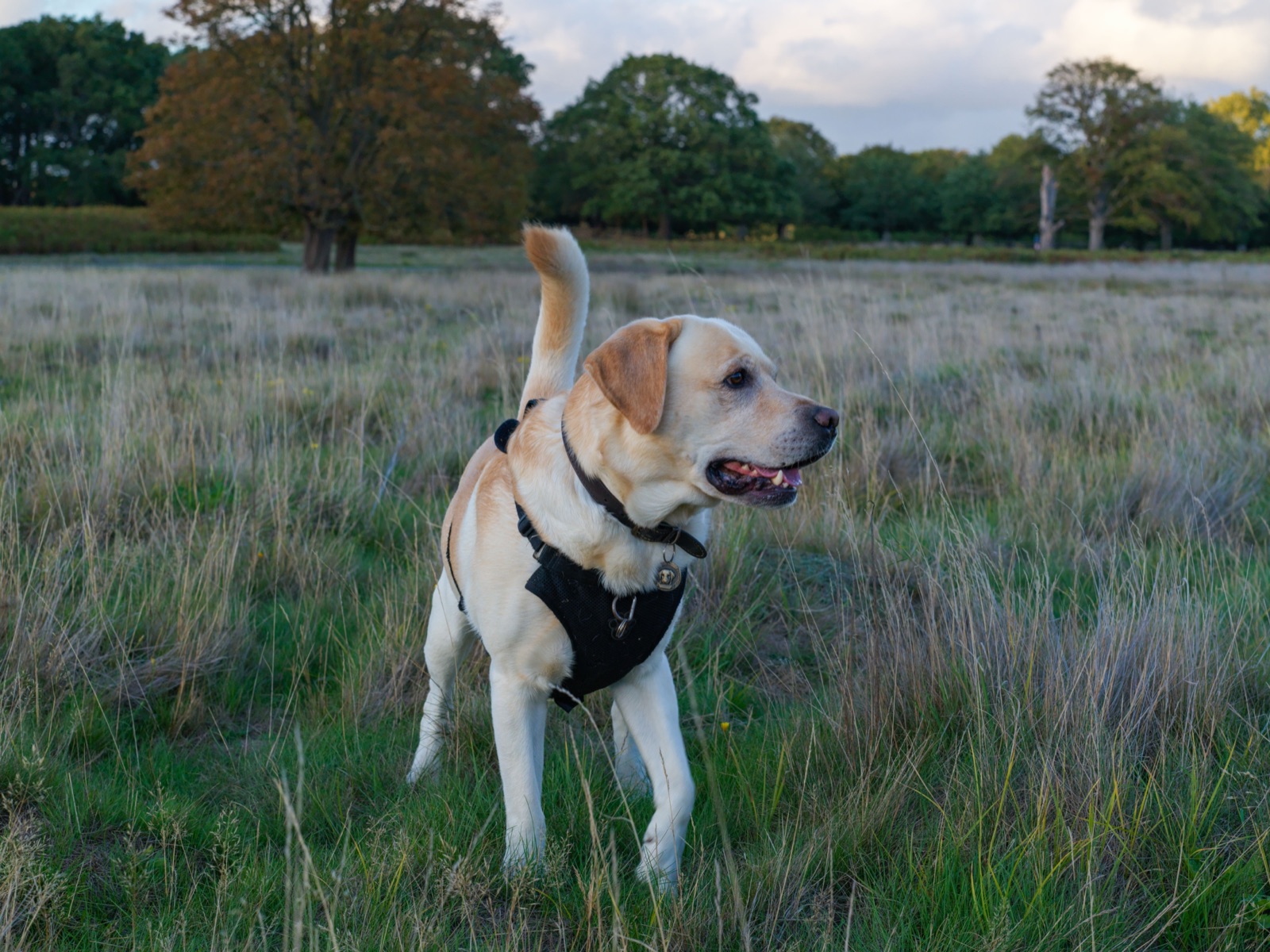
A harness for a Labrador spreads the pull of the leash across the chest instead of the throat. That matters for a strong, excitable 55–80 lb dog that sees a duck, a dog or a dropped sandwich and lunges. This guide explains the clip types (front, back and dual), how to measure and fit a Lab, what changes for puppies and for the car, and how to look after the harness.
Why a Lab benefits from a harness
The AKC notes that a body harness can prevent potential throat damage if your dog pulls, and it recommends harnesses for dogs that tug on the leash. Labs are friendly and enthusiastic, and many pull simply because everything is interesting. A harness doesn't teach your dog to walk nicely on its own, but it makes the learning safer and more comfortable for both of you.
On this site we recommend reward-based training only. A harness is a tool for comfort and control, not a correction: no choke, prong or shock collars.
Types of dog harness
Front-clip harness
The leash ring sits at the chest. The AKC says a front clip helps redirect a pulling dog's forward movement and gives you leverage when your dog pulls. The trade-off is convenience: the AKC notes the ring near the chest makes clipping on less convenient.
Some "no-pull" designs go a step further: the AKC describes a front D-ring harness that tightens slightly when the dog pulls. If you want a harness that works only by redirecting, look for a front-clip model that does not tighten.
Back-clip harness
The ring sits between the shoulder blades. The AKC describes back-clip harnesses as easy to use and best for well-trained dogs. For a Lab that already walks on a loose leash, a back clip is simple.
Dual-clip harness
Both rings on one harness. The AKC suggests these are useful while you are teaching your dog: start on the front clip for control and move to the back clip as your Lab improves. For a young Lab that pulls now but won't forever, a dual-clip harness is the one you are least likely to replace.
Step-in or over-the-head
Step-in harnesses let your dog step into the leg loops so nothing slides over the head. The AKC notes they are harder for escape-prone dogs to slip out of when fitted properly. Over-the-head styles work just as well if they fit.

Comparison table
| Type | Leash ring | Best for | Watch out for |
|---|---|---|---|
| Front-clip | Chest | Labs that pull | Less convenient to clip on; some designs tighten |
| Back-clip | Between shoulder blades | Labs that already walk well, hiking | Little help with pulling |
| Dual-clip | Both | Young Labs in training | More straps to adjust |
| Step-in | Usually back | Dogs that dislike things over the head | Must be fitted closely to stop escapes |
What to look at before you buy
How to measure your Lab
The AKC says to measure the base of the neck, where it meets the shoulders, and the widest part of the chest, just behind the front legs. Ruffwear's size guide gives the same girth point and suggests using a string and a ruler if you don't have a soft tape. Measure with your dog standing.
Then use the maker's own chart; sizes are not standard between brands. As an example, Ruffwear's harness chart runs M at 27–32 inches girth, L at 32–36 inches and XL at 36–42 inches. Where your Lab falls depends on your dog, not the breed label, so a black Lab harness and a chocolate Lab harness are chosen exactly the same way.
How it should fit
- Two fingers. The AKC's advice is a snug fit with room for two fingers under the straps, but not so tight that it is uncomfortable.
- Neck opening. It should sit near the top of the breastbone, not around the throat.
- Shoulders free. Watch your dog walk. The front legs should move forward and out to the side without the harness getting in the way, and the girth strap should sit clear of the backs of the front legs.
- No escape. The AKC suggests checking that the harness doesn't slide over the head; backing your dog up a step or two is an easy way to test it.
The AKC warns that a poorly fitted harness can rub fur and skin, let a dog slip out, or change the way it moves.
Material
The AKC compares the common materials: nylon is durable and affordable but traps heat; leather lasts but costs more and needs conditioning; mesh is breathable but less padded and can chafe; neoprene suits swimmers but holds heat and moisture. If your Lab swims often, keep in mind which materials hold water and heat.
Dog harness for a Labrador puppy
Fit the harness to your puppy's current measurements, not the adult size; Ruffwear notes that gear that is too large or too small can cause chafing or slipping, and suggests the larger size if a growing puppy falls between two. The AKC advises rechecking the fit after growth spurts. You may need more than one size before your Lab is grown. Introduce it with treats and short sessions so your puppy likes putting it on.
Harnesses in the car
A walking harness is not a car restraint. The Center for Pet Safety (CPS) certifies pet travel products that meet its standards, with a category for car safety harnesses. When we checked in November 2026, its list showed crates and carriers but no harnesses, so check the current list before you rely on a harness in the car. CPS also warns never to attach an extension tether or zipline, which give a dog too much movement in a sudden stop. More on car travel and seat protection is in our dog car seat cover guide.
Which type suits whom
- Adult Lab that pulls hard: front-clip or dual-clip, plus reward-based loose-leash training.
- Lab puppy: an adjustable dual-clip harness sized for now, replaced as your dog grows.
- Calm adult Lab that walks well: a back-clip harness.
- Lab that backs out of things: a closely fitted step-in harness, checked with the backing-up test.
- Lab that rides in the car: check the CPS Certified list for a current car harness, or use a certified travel crate strapped down.
How to use and care for a harness
Harness routine
Daily checks
Look for rubbing behind the front legs and under the chest, especially after long walks or swims. The AKC says daily wear is fine only if the harness fits properly, stays in good condition and doesn't cause rubbing.
Re-fit after changes
Recheck the fit after grooming and after weight changes, since a harness that fit last month can loosen or pinch now.
Cleaning
Rinse off salt or lake water, let the harness dry fully, and clear hair and debris out of any hook-and-loop fasteners so they keep holding. Follow the maker's washing instructions.
Training goes with it
Reward your Lab for walking beside you with a loose leash; the harness only makes those walks easier while you practice. Our toy guide has ideas for burning off energy before a walk, and the training section covers leash skills.
Questions
What kind of harness is best for a Labrador that pulls?
A front-clip or dual-clip harness. The AKC explains that a front clip at the chest helps redirect a pulling dog's forward movement, while a back clip between the shoulder blades suits dogs that already walk well. Pair it with reward-based leash training.
How tight should a harness be on a Lab?
Snug but not tight. The AKC suggests you should be able to fit two fingers under the straps, the harness shouldn't slide over your dog's head, and the front legs and shoulders should move freely.
How do I measure my Lab for a harness?
Measure the girth: the widest part of the chest, just behind the front legs, with your dog standing. Many makers also ask for the neck at the base, where it meets the shoulders. Compare both with the maker's size chart.
Can a Lab puppy wear a harness?
Yes. Fit it to the puppy's current measurements, recheck the fit after growth spurts as the AKC advises, and move up a size as your Lab grows.
Is a walking harness safe in the car?
Not as a crash restraint. A walking harness is made for walks; the Center for Pet Safety certifies car restraints that meet its standards and warns never to add an extension tether or zipline.
Sources
- American Kennel Club — How to find the right dog harness for your dog
- American Kennel Club — The importance of a well-fitting harness
- American Kennel Club — Dog harnesses and dog collars: which is right for your dog?
- Ruffwear — Size guide
- Center for Pet Safety — CPS Certified products
- Center for Pet Safety — Extension tether advisory
More in Gear
Guide in Activity
How much exercise does a Lab need? Adults, puppies and seniors
A healthy adult Lab needs a lot of daily exercise, a puppy needs short sessions and plenty of rest, and every Lab needs work for its brain too.
Buying guide
Dog car seat cover for a Labrador: hammock, bench, bucket or cargo liner
A cover keeps mud, water and hair off the seats. It does not keep your Lab safe in a crash, so plan the restraint too.
Buying guide
Best toys for a Labrador: retrieving, puzzle, tug, water and chew toys
Labs were bred to carry things in their mouths. Pick toys by job, size them for a big mouth, and put the risky ones away after play.